
The Divorce Mortgage Planning Report™.
A structured analytical report, not a loan estimate, not a pre-qualification letter. The Divorce Mortgage Planning Report™ is the definitive deliverable that translates a divorce settlement into a mortgage and real property reality. Produced by a Certified Divorce Lending Professional (CDLP®) using the four-phase Mortgage Capacity Mapping™ framework developed by the Divorce Lending Association.
Are you an attorney, mediator or financial professional? The professional view of this report, including the framework and who may produce one, is on the association’s site.
divorcelendingassociation.com ›Divorce settlements get drafted in one room. Mortgage feasibility gets evaluated in another.
Most divorce settlements are negotiated on the legal side of the table. Mortgage qualification, equity buyout structure, refinance feasibility, and post-divorce housing sustainability are evaluated on the lender side, usually months later, after the agreement is signed.
The two sides almost never meet at the same table until the refinance application fails or the assumption falls through. By then the settlement is already a court order.
This is not a loan estimate. It is a strategic analysis grounded in a defined methodology.
A pre-qualification letter takes ten minutes. A loan estimate is a transaction document. Neither one tells a divorcing homeowner whether the housing decision actually works inside a divorce, or whether the settlement language being drafted will hold up when the lender reviews it.
The Divorce Mortgage Planning Report is built on Mortgage Capacity Mapping, the four-phase analytical framework developed by the Divorce Lending Association. Each phase examines a different layer of the housing decision and integrates with the others to produce a defensible, comprehensive picture.
Property Feasibility Analysis
Examines whether keeping, selling, or transferring the home is even possible under lending guidelines. Evaluates value, equity, title structure, assumption eligibility, and long-term affordability.
Income Qualification Structuring
Evaluates how divorce affects income eligibility. Considers support timelines, employment changes, self-employment complexities, and when income becomes usable for qualification.
Debt Allocation Impact Modeling
Analyzes how marital and individual debt affect debt-to-income ratios. Evaluates indemnification language, equalization payments, and the overall impact of debt on loan approval.
Equity & Cash Flow Solutions Engineering
Designs the structures required to achieve the intended outcome. Includes equity buyouts, refinance pathways, sale-proceeds planning, and long-term sustainability under lending rules.
Together, these four analytical phases give the divorce team a structured, professional methodology for evaluating a client’s mortgage capacity. This is what differentiates a CDLP® from a traditional mortgage loan officer, and what differentiates the Divorce Mortgage Planning Report from anything else available in the market.
Four pages from the report itself.
It is easier to show you than to describe it. This is the real document, prepared for a sample client so the numbers can stay on the page.
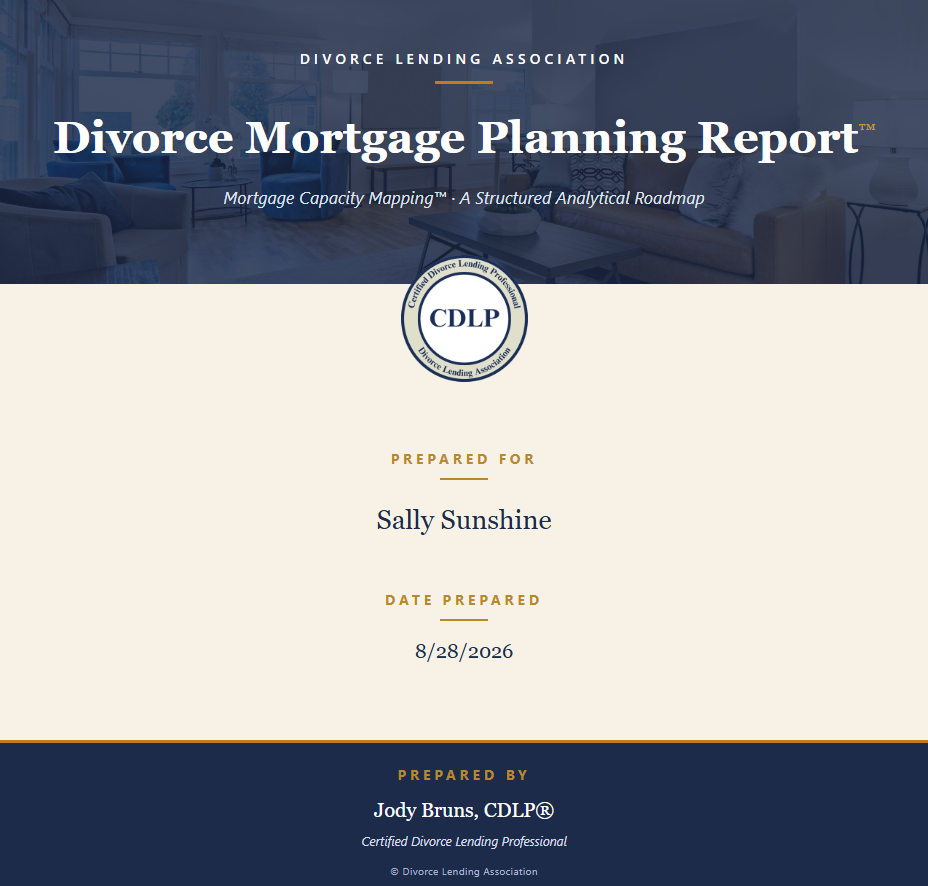
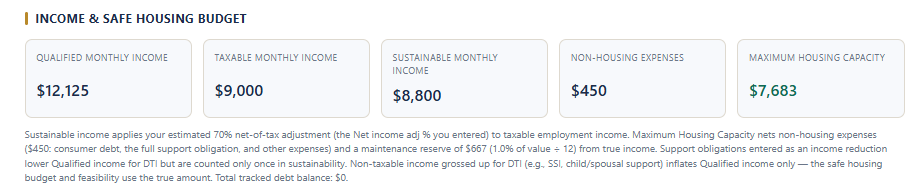
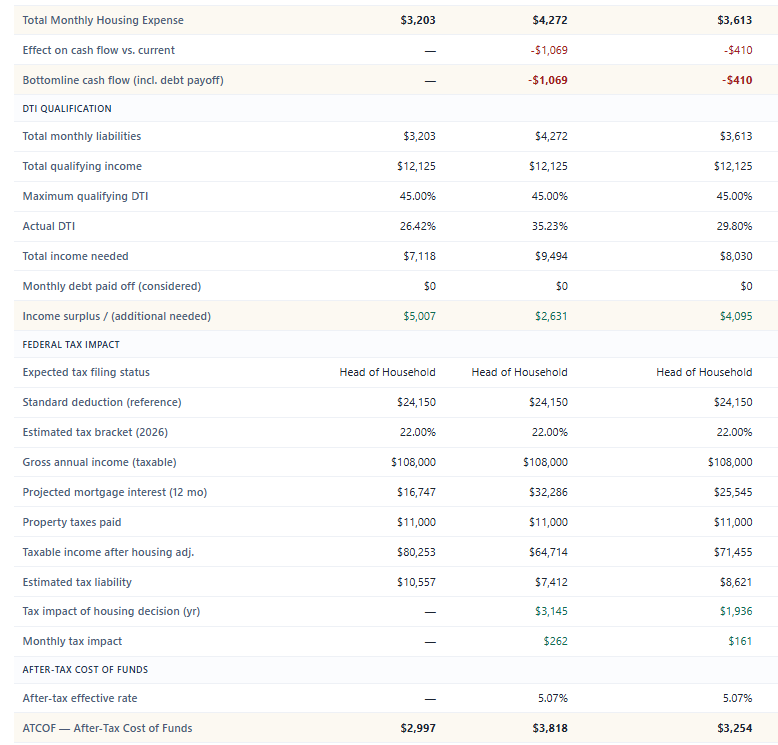
Tap or click to view full size.
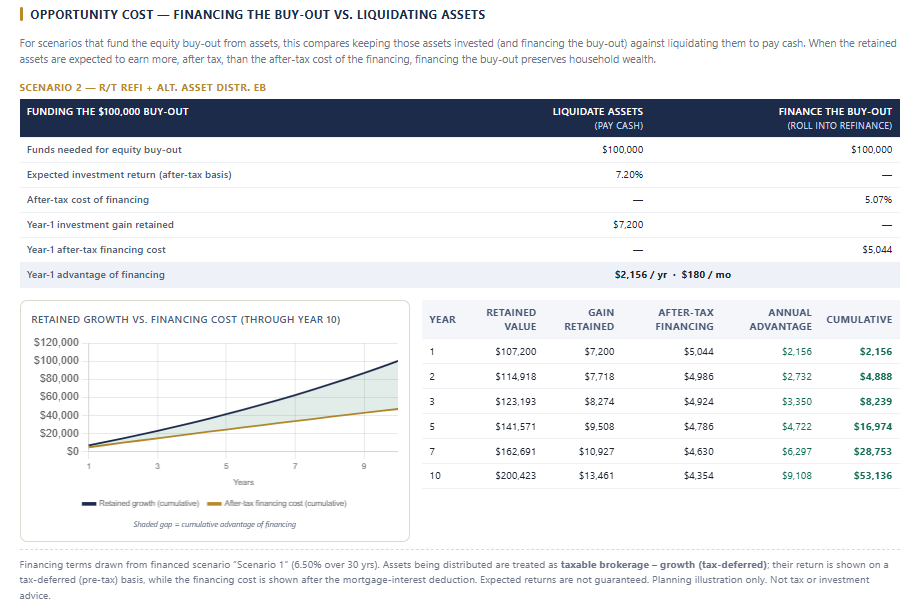
Figures shown are a sample prepared for illustration, not a client file. Every report is built from the actual numbers in the case. Projections involving tax and investment return are planning illustrations, not tax or investment advice.
A complete picture, from intake through executable plan.
Every Divorce Mortgage Planning Report integrates the same structured analytical sections, tailored to the client’s situation, divorce stage, and housing objective.
Executive Summary & Strategic Findings
Primary conclusion, case framing, key findings, risk level, and recommended next steps, the page the divorce team reads first.
Property Details & Real Property Reconciliation
Valuation, equity, title and vesting, deed type, insurance, liens, and projected future value.
Financial Details & Safe Housing Budget
Income sources, support income with timeline considerations, asset distribution, debt obligations, and the sustainable housing budget analysis.
Equity Buyout & Refinance Scenarios
Side-by-side modeling of refinance, second-mortgage buyout, and combined structures, with full payment, LTV, and cash-flow comparisons.
Reverse Mortgage Strategy
Where age-eligible, evaluation of HECM, proprietary, reverse purchase, and reverse HELOC strategies as alternatives or complements.
Purchase Options for Transitioning Households
When the client is exiting the marital home, modeling of purchase scenarios, financing structure, and post-divorce housing impact.
Financial Snapshots
Housing-cost comparison, tax-impact gap, income-qualification position, and equity-vs-debt overview across every scenario.
Risk Identification & Feasibility Classification
Documented risk factors and feasibility classification: Feasible Now, Feasible with Conditions, Feasible Later, Not Currently Feasible, Approvable but Not Sustainable, or Legally Possible, Lending-Challenged.
Documentation Checklist & Fee Breakdowns
Itemized closing-cost and prepaid breakdowns for each modeled scenario, plus the documentation roadmap to move from plan to execution.
The answers you actually need, before you sign.
The real question during a divorce isn’t “do I qualify?” It’s “will this work?” The Divorce Mortgage Planning Report answers the second question, in writing, in numbers, on paper you can take back to your attorney.
What you leave the report knowing.
- Which housing pathway the lender can actually support
- What an equity buyout structure looks like in real numbers
- Whether the proposed monthly payment is sustainable on post-divorce income
- What needs to change in the settlement language to make the plan workable
- The risk factors that could collapse the plan if they aren’t addressed now
Your attorney, mediator or financial neutral works from the same report you receive. What each of them does with it is set out on the association’s site: what the Divorce Mortgage Planning Report contains ›
Developed by the Divorce Lending Association. Produced exclusively by CDLP® professionals.
No other report in the country integrates property feasibility, income qualification, debt allocation, and equity engineering into a single client-ready document, built to the standard of analysis required in family law mediation, drafting, and litigation.
Developed by the Divorce Lending Association and produced only by a Certified Divorce Lending Professional in good standing. The association publishes the standards that requirement rests on.
What people ask before they request the report.
Is this a pre-qualification letter or a loan estimate?
No. A pre-qualification addresses one question: whether a borrower qualifies for a loan today. A loan estimate is a federally required disclosure tied to an actual loan application. The Divorce Mortgage Planning Report addresses something different and broader, whether the entire housing decision is feasible, sustainable, and aligned with both lending guidelines and settlement intent. It is a structured analytical report, not a transactional document.
Who produces the report?
The report is produced exclusively by a Certified Divorce Lending Professional (CDLP®) credentialed by the Divorce Lending Association. CDLP® professionals are trained in the four-phase Mortgage Capacity Mapping framework that drives the analysis, and continuing education is required to maintain the credential.
Will my attorney and mediator actually use it?
That is what it is built for. Your attorney can draft settlement language against numbers a lender has already verified, your mediator can work from figures neither side has to argue about, and a financial neutral or CDFA can fold the mortgage reality into the cash flow and asset modeling. It is one report, and each of them reads it for a different section.
What stage of the divorce is the right time for the report?
The report is most powerful before the settlement is finalized, pre-filing, in mediation, or during negotiation. It can also be produced post-decree when a refinance, assumption, or buyout is being executed, but the strategic value is highest when there is still room to influence the settlement language.
Is the report the same as the free Mortgage Capacity Strategy Review?
No. The Mortgage Capacity Strategy Review is a free first conversation with a CDLP® that establishes direction. The Divorce Mortgage Planning Report is the in-depth, fee-based deliverable that follows when a full structured analysis is the right next step.
How do I get a report prepared?
Start with a free Mortgage Capacity Strategy Review. It is the entry point into the process, it costs nothing, and it establishes whether the full report is the right next step for your situation.